French Polynesia · Practical
Moorea, and the Last Boat
The first boat off Moorea leaves at twenty past five in the morning.
Not for tourists. For people who live on Moorea and work in Papeete, and who cross a channel to get to the office the way other people take a train. Commuters fill the weekday morning and late-afternoon boats, in both directions, for exactly that reason.
This tells you something the brochures do not. Moorea is thirty minutes from the capital of French Polynesia, and it is a commuter island as much as it is a paradise. Both facts are true at once, and the trip improves considerably once you stop expecting only the second one.
Smart Summary
- Take the ferry, never the plane. Twenty kilometres, half an hour, and a fraction of the cost. Flying this route is money spent to see less.
- Foot passengers do not need to book. Buy at the counter half an hour before departure and walk on.
- A vehicle is different — book at least 24 hours ahead. This is the trap.
- The last boat back to Tahiti is late afternoon, not evening. A day trip ends before dinner, which is the strongest argument for not making it a day trip.
- Two nights minimum. Moorea is the island most people wish they had given longer, and the reason is structural, not sentimental.
The crossing
Boats run between the commercial port in central Papeete — walkable from the market — and the dock at Vaiare on Moorea’s east coast. Several operators now work the channel, and the fast catamaran does it in about half an hour.
On foot, it is simple. No reservation. Turn up at the counter, buy a ticket about thirty minutes before departure, get on. Sit on the open upper deck if the weather allows; the approach to Moorea, with the peaks sharpening as you close on them, is the best half-hour of transport in the territory and it costs less than lunch.
With a car, it is not simple. Vehicles must be booked a minimum of twenty-four hours ahead, on the larger ferry rather than the fast boat, and turning up hoping for space is how people lose a day. Decide early whether you need one — for two nights on the island, you probably do.
First departures from Papeete are around six in the morning. The last crossings in both directions fall in the late afternoon, roughly quarter past to quarter to six.
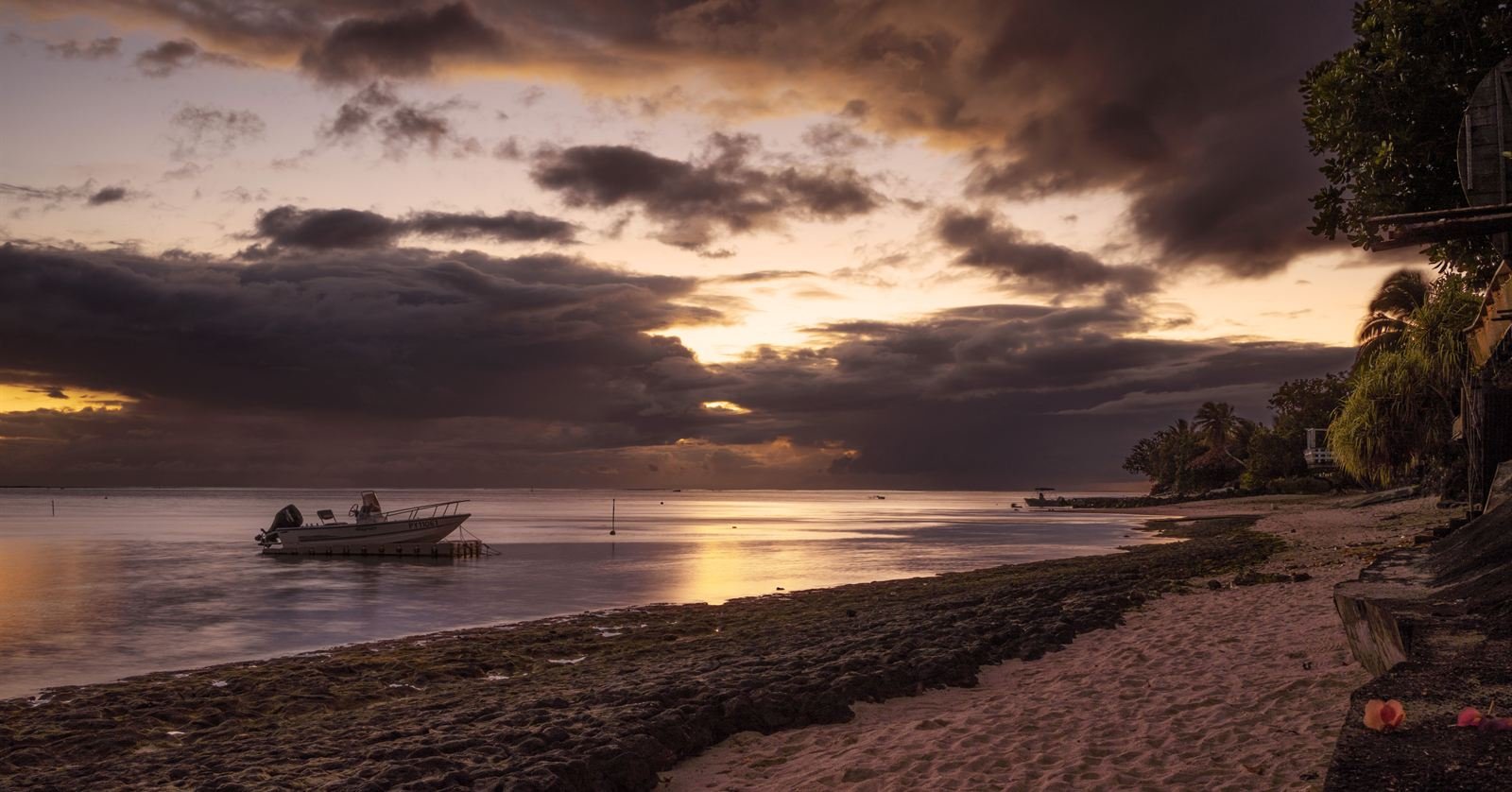
That last detail governs everything. If you come over for the day, you are on a boat home while the light is still good, and Moorea’s light in the last hour is the thing people remember. Stay the night and you keep it.
What the island is shaped like
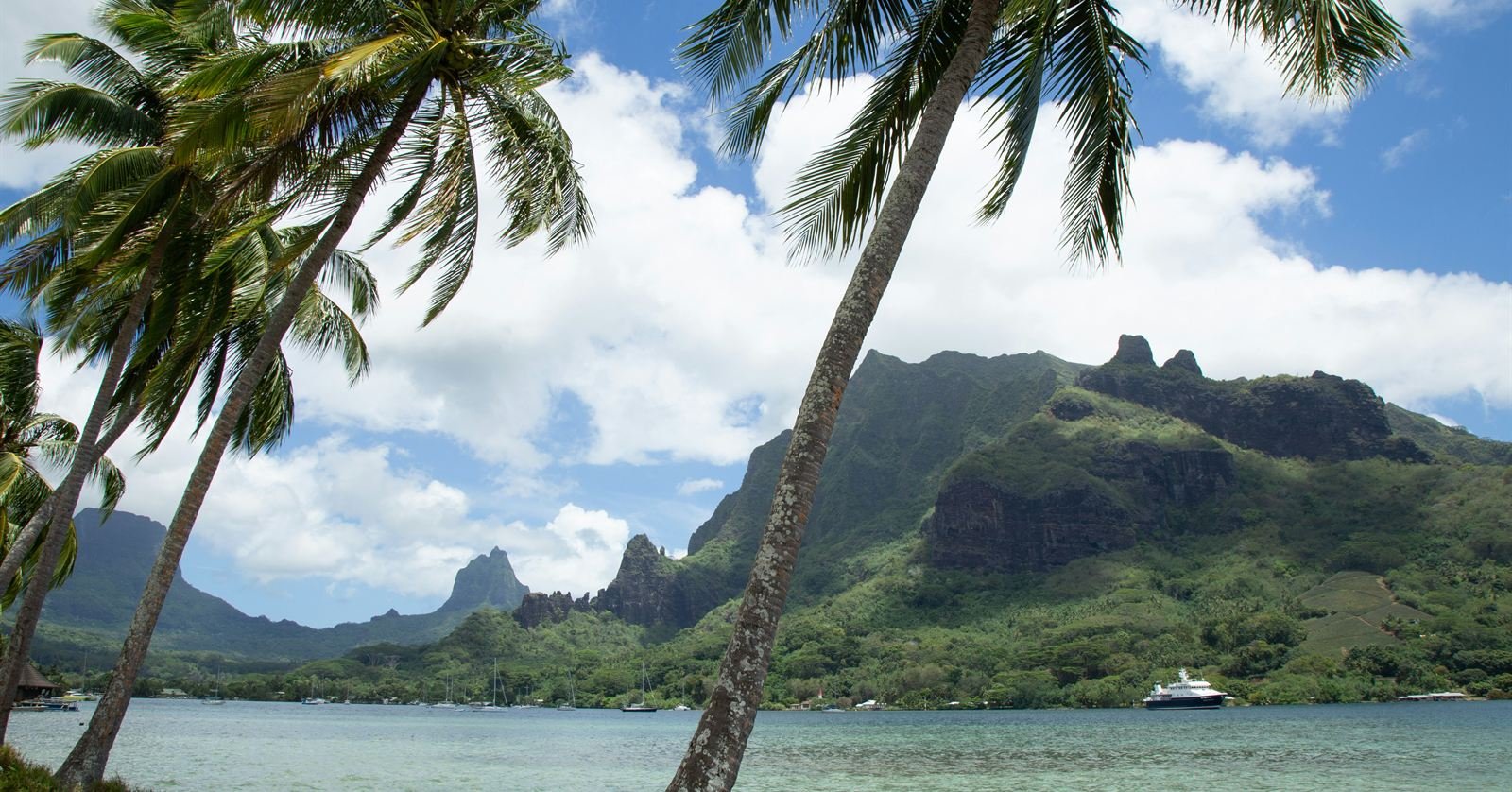
Two deep bays cut into the north coast — Cook’s Bay and Opunohu — separated by a ridge, with a ring of jagged basalt peaks behind them and a single road around the outside.
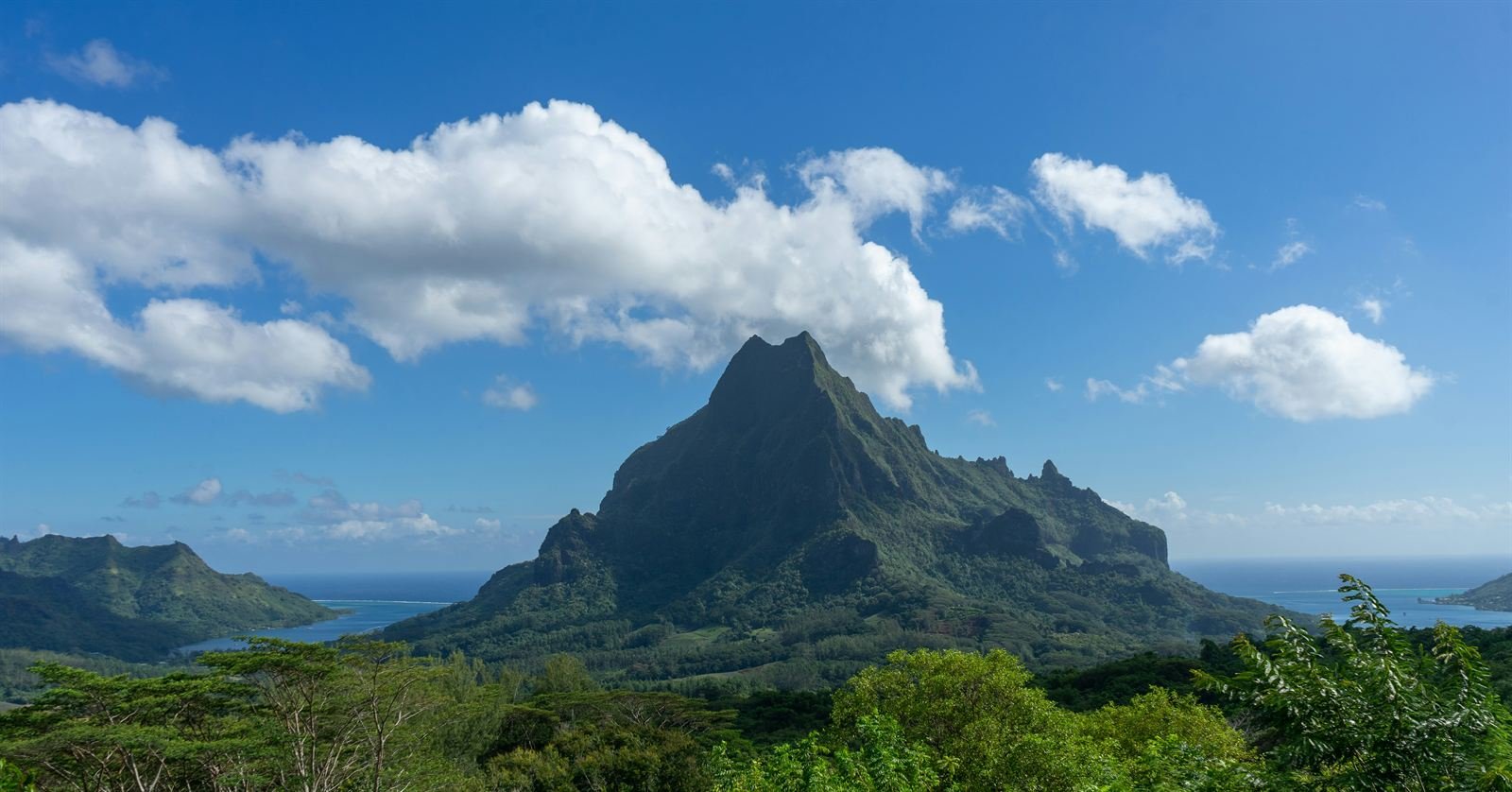
That geometry does most of the work. The bays give you the postcard from sea level, and the ridge between them gives you the view down into both at once from the Belvedere lookout, reached by a road that climbs inland through what used to be pineapple plantations and in places still is.
The interior valley behind the bays holds marae — pre-European ceremonial platforms in stone — set in the trees on the way up. They are unlabelled in the way things are when nobody has decided to make an attraction of them, and they are the reason to drive up slowly rather than straight to the viewpoint.
The lagoon on the north coast is shallow and pale and full of rays. The south coast is quieter, less built, and where we would stay if the point is not to be near anything.
Where we would stay
Booking through these links may earn Sharp Voyage a commission, at no extra cost to you. It does not change what we recommend. How this works.
Four addresses carry the island, and they are spread around it in a way that makes the choice simpler than it looks: two on the north coast between the bays, one on the east coast by the ferry, and one small one on Cook’s Bay.
Sofitel Kia Ora Moorea Beach Resort sits at Temae on the east coast, minutes from the ferry dock and the airfield, on a beach inside the area the island protects under its lagoon management plan. It reopened in April 2026 after the common areas were rebuilt, which most of what you will read online has not caught up with. A hundred and nine villas, and the resort publishes the breakdown rather than rounding it: thirty-eight overwater, eleven on the beach, nine facing the lagoon, fifty in the gardens and one luxury villa. A marine biologist runs coral propagation on site, and you can sponsor a coral.
Hilton Moorea Lagoon Resort & Spa is on the north coast, between Cook’s Bay and Opunohu — the stretch with the white sand and the postcard. Overwater villas with glass panels in the floor, beach and garden bungalows with plunge pools and outdoor showers. The excursion desk is on site, which matters here, because this is the coast the ray trips leave from.
Manava Beach Resort & Spa Moorea is at Maharepa, also minutes from the ferry and the airfield. Ninety rooms and bungalows across eight categories, from overwater through beach and garden bungalows to duplexes with a kitchenette — a wide spread, and the reason it works for a family or a longer stay. Its garden pool bungalows are fitted for reduced mobility, which is worth stating plainly because nowhere else on the island says it.
Hôtel Kaveka is the small one, family-run, on the water in Cook’s Bay with the mountains behind, and its restaurant stands on stilts over the bay. It is a different proposition and a different price from the three above, and it is the address we would pick if what you want is to be on Moorea rather than at a resort on Moorea. Rooms are quoted with the government, sales and local taxes already in them.
One thing to expect on your bill. A local accommodation tax is collected by the property on top of most rates, and French Polynesia is changing how it works: each commune sets its own scale, and the new system applies to stays from 1 January 2027. Any figure we printed today would be wrong by the time you travel, so we are not printing one — ask the property what it will be for your dates.
Two nights, and what to do with them
Day one, the road. Circle the island. It takes a couple of hours with no stops and most of a day with them. The bays, the coastal villages, the beaches on the north-west corner.
Day two, upward. The Belvedere in the morning before the cloud settles on the peaks, the marae on the way, and a walk if the weather holds — the interior tracks between the bays are proper walking, not a stroll, and they are empty.
Both days, the water. Snorkelling straight off the beach on the north coast is the everyday version. The lagoon tours are the organised version. Either works.
If you have a third night, the correct use of it is to do less.
Where it sits in a trip
Moorea is the easiest island in French Polynesia to reach and the one most often compressed into a day.
Our view: it is the better value proposition than Bora Bora for most visitors, and the two are not really competing. Bora Bora sells a lagoon and a bungalow at rates that match its fame. Moorea sells an island you can drive around, walk into and afford, half an hour from the capital.
If the budget is finite and the choice is one or the other, we would take four nights on Moorea over two on Bora Bora, and we are aware that is not what the photographs suggest.
When to go
May to October for the dry season and the reliable weather, at peak rates.
November to April is wetter, cheaper, and carries the honest warning that the channel crossing can be rough in the wet season. If you are prone to seasickness, that half-hour is short but it is open water.
What we would skip
Flying. Covered above, still true, people still do it.
The day trip, unless the alternative is not seeing Moorea at all. You will spend an hour on boats and leave before the island does its best work.
Half an hour from a capital city there is an island with two bays, a ring of peaks, stone platforms in the trees and a road you can drive in an afternoon.
Most visitors see it from a ferry seat on a return leg. Get off the boat and stay.
Join