Swedish Lapland · Culture & Design
Kiruna Is Rebuilding Itself While You Watch
Most cities that change do it slowly enough that nobody notices until it’s finished. Kiruna is doing the opposite. It is moving itself, building by building, three kilometres east, in full view, over a span of decades — and you can visit it mid-sentence, so to speak, while the move is still happening.
That’s the whole reason to go. Not the finished city. The unfinished one.
Why a city walks
Kiruna sits on top of the largest underground iron ore mine on the planet, and the mine is the reason the town exists at all — LKAB, the state mining company, built Kiruna to house its workers in 1900. For a century that arrangement worked. Then it stopped working, because a century of extraction had begun destabilising the ground the town was standing on: cracks, sinkholes, a slow structural failure spreading outward from the mine’s edge.
The solution, decided in the early 2000s, was not to close the mine. It was to move the city. Roughly 6,000 people are being moved out of the unsafe old town into a newly built centre — a process that is well under way rather than finished. The first houses were physically relocated in 2017, the first new homes were ready for occupancy in 2021, and residents are given a choice: a new home built to match the old one, or, where structurally possible, the original house transported and re-erected on the new site.
A second wave is now confirmed and larger than the first. LKAB’s revised deformation forecast, published in August 2025, put roughly another 6,000 residents and close to 3,000 further homes inside the affected zone — roughly doubling the area everyone had been planning around. The phasing that followed is explicitly preliminary: LKAB has sketched a first stage running 2028–2032, with residents told they can expect to stay in their current homes for something like four to eight years depending on where they live, and both the company and the municipality have been careful to say the land needed for it is not all secured yet. Kiruna Municipality frames the outer bound as ten years from 2025 — so 2035 — for winding down everything inside the new impact area.
This is not a metaphor and not a tourist gimmick. It is one of the largest civil relocations in modern Europe, done in public, and it is still going on.
What’s actually there to see
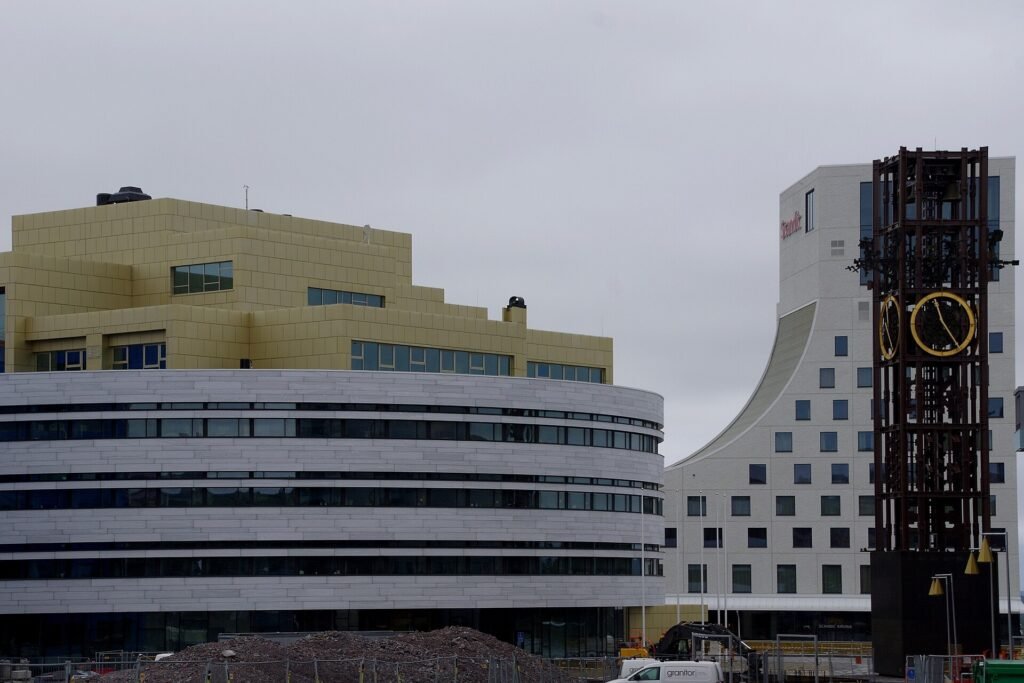
Kristallen, the new town hall, was inaugurated in 2018 as the first building of the new centre — an angular crystalline structure that took its geometry from the iron ore itself, designed to hold the town’s civic and social life during a period when almost everything else was in flux. It’s the anchor point most visitors start from, and reasonably so.
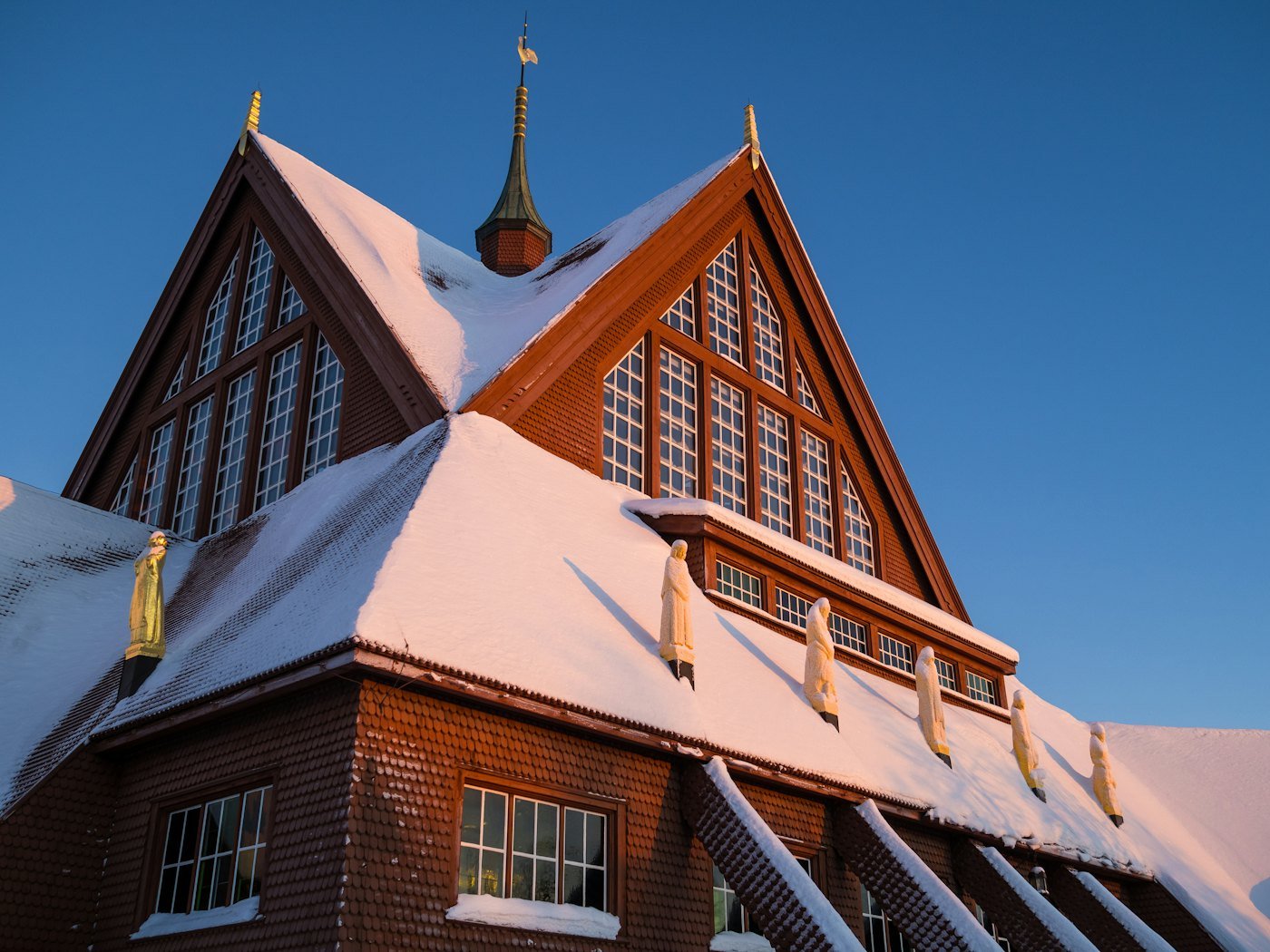
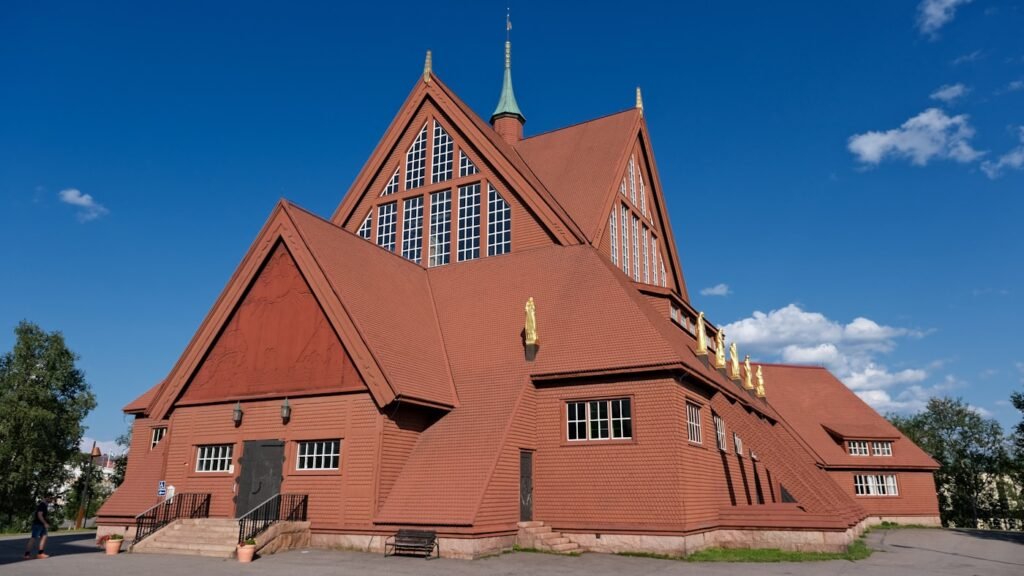
The more striking thing, though, happened in August 2025. The Kiruna Church — a 672-tonne, 1912 wooden building once voted Sweden’s finest building constructed before 1950 — was moved five kilometres on remote-controlled trailers, at a walking pace of roughly half a kilometre an hour, across two days. The bell tower followed a week later.
Be clear about what you can and can’t see, though: the church is closed to visitors, and has been since June 2024 — more than a year before the building was moved at all. Groundwork around the new site and restoration of the interiors are still going on, and the parish’s stated plan is to reopen it during 2027 — no month has been announced, and the date has already moved once. Until then it is an exterior. That it survived the move intact, rather than being rebuilt from scratch, is still the whole point, and it is still worth standing in front of.
Between the two is the gap — literally, the strip of ground between old Kiruna and new Kiruna, where demolition and construction are visibly happening side by side. Don’t treat it as a walking route. LKAB fences buildings off before it clears them, and the perimeter moves as the work advances through 2027, so ground that is open one season is behind a hoarding the next. Guided walking tours cover the architecture and the social history of the move, and they’re worth taking for that reason as much as any other: a lot of what you’re looking at only makes sense with someone giving you the context standing next to it, and a local guide knows what is actually accessible on the day. Be aware that these run through small local operators rather than on a published timetable — there is no fixed schedule to book against, so contact the Kiruna Lapland tourist office ahead of your dates rather than assuming a departure will be waiting.
The part that isn’t clean
We’d be doing this piece a disservice if we let it read as pure architectural triumph. It isn’t only that.
The relocation has real critics, particularly among the Sámi, the indigenous people whose word gave Kiruna its name and who have herded reindeer through this land for far longer than the mine has existed. The expanded mining footprint and the town’s move both intersect with traditional reindeer migration routes, and that tension hasn’t been resolved by good architecture. If you spend time at the LKAB mine tour or the exhibitions on the city’s transformation, the Sámi perspective is worth actively seeking out rather than assuming the celebratory version is the whole story.
Where this fits with the rest of Swedish Lapland
Kiruna is 17 km from the ICEHOTEL in Jukkasjärvi and close enough to Abisko to combine easily — most visitors doing a Lapland trip end up passing through Kiruna’s airport regardless, since it’s the main gateway to the region. That makes it less a standalone destination than a base with its own reason to stay a night, rather than just changing planes. If the aurora is what brought you this far north, our guide to where to actually sleep for it covers the Abisko end of the same trip.
It’s also, unusually for this part of the world, walkable and small enough to see properly in a day — which makes it the right place to break up a longer aurora- or wilderness-focused trip with something urban and strange.
When to go
Any season works for the town itself, since the story is architectural, not seasonal. But the August 2025 church move is a reminder that the project reaches milestones worth timing a visit around — check LKAB and Kiruna Municipality’s public updates before booking, since the relocation calendar shifts, and has shifted already.
Winter adds the obvious bonus: Kiruna sits well inside the aurora zone, so a night here pairs naturally with the Abisko or Jukkasjärvi legs of a Lapland trip without requiring a separate journey.
Join