Swedish Lapland · Sensory
A Room That Will Not Exist by June
The first strange thing about the ICEHOTEL is not the cold. It’s the knowledge, sitting quietly under everything else you feel that night, that the room you’re standing in was carved a few weeks ago from a river, and will be a river again by early summer.
Nothing else you sleep in works this way. A hotel room is normally the most permanent-feeling thing about a trip — the one fixed point. Here the fixed point is gone, replaced by something that is, structurally, weather.
What’s actually frozen, and what isn’t
Jukkasjärvi, a village on the Torne River seventeen kilometres from Kiruna, has been rebuilding a hotel from that river’s ice every winter since 1989. Come December, teams begin cutting and hauling ice from the Torne itself — one of Sweden’s last untouched major rivers — and by the season’s opening the following month, a new hotel exists that did not exist the winter before: different rooms, different artists, different sculpture, because it has to be built from nothing each time.
By spring it starts to give itself back. The seasonal building melts into the river across April and May, and by June there is, structurally speaking, no hotel there at all.
What survives is ICEHOTEL 365 — a separate, permanent structure next door, kept below freezing year-round using solar power gathered during the near-endless daylight of the Arctic summer. It’s a genuinely strange piece of engineering: between May and July, 875 square metres of solar panels convert continuous daylight into cooling energy and hold the interior at a constant minus five degrees. The same midnight sun that would otherwise melt an ice hotel is what runs the machinery keeping one frozen through July.
The 365 building covers around 2,100 square metres and holds eighteen art and deluxe suites, an ice gallery and the ICEBAR. It’s the reason you can have this experience in August as easily as January — though it is a more contained building than the sprawling seasonal one, and it is worth knowing that before you book a summer trip expecting the version from the photographs.
The night itself
You don’t spend the whole night in the cold room, whatever the marketing implies. The routine, refined over three and a half decades, is: check in to a heated room first, spend the evening as you like, then move into the ice suite late — with a full orientation on the thermal sleeping bag and the sleeping technique first, because doing it wrong is genuinely uncomfortable, and doing it right is not.
The rooms themselves range from plain ice chambers to Art Suites, each carved by a different visiting artist for that single season only — meaning the room you book will never be booked by anyone again after the ice melts. That’s not a marketing line; it’s structurally true.
Booking through this link may earn Sharp Voyage a commission, at no extra cost to you. It does not change what we recommend. How this works.
A cold-room stay bundles the thermal gear, the orientation, sauna access and breakfast the next morning in one of the warm buildings. On price, be careful what you trust: ICEHOTEL publishes no public rate card, and rates move by date and by room category inside the booking engine. The figures that circulate on comparison sites and tour-operator pages are their numbers, not the hotel’s. Price it for your own dates.
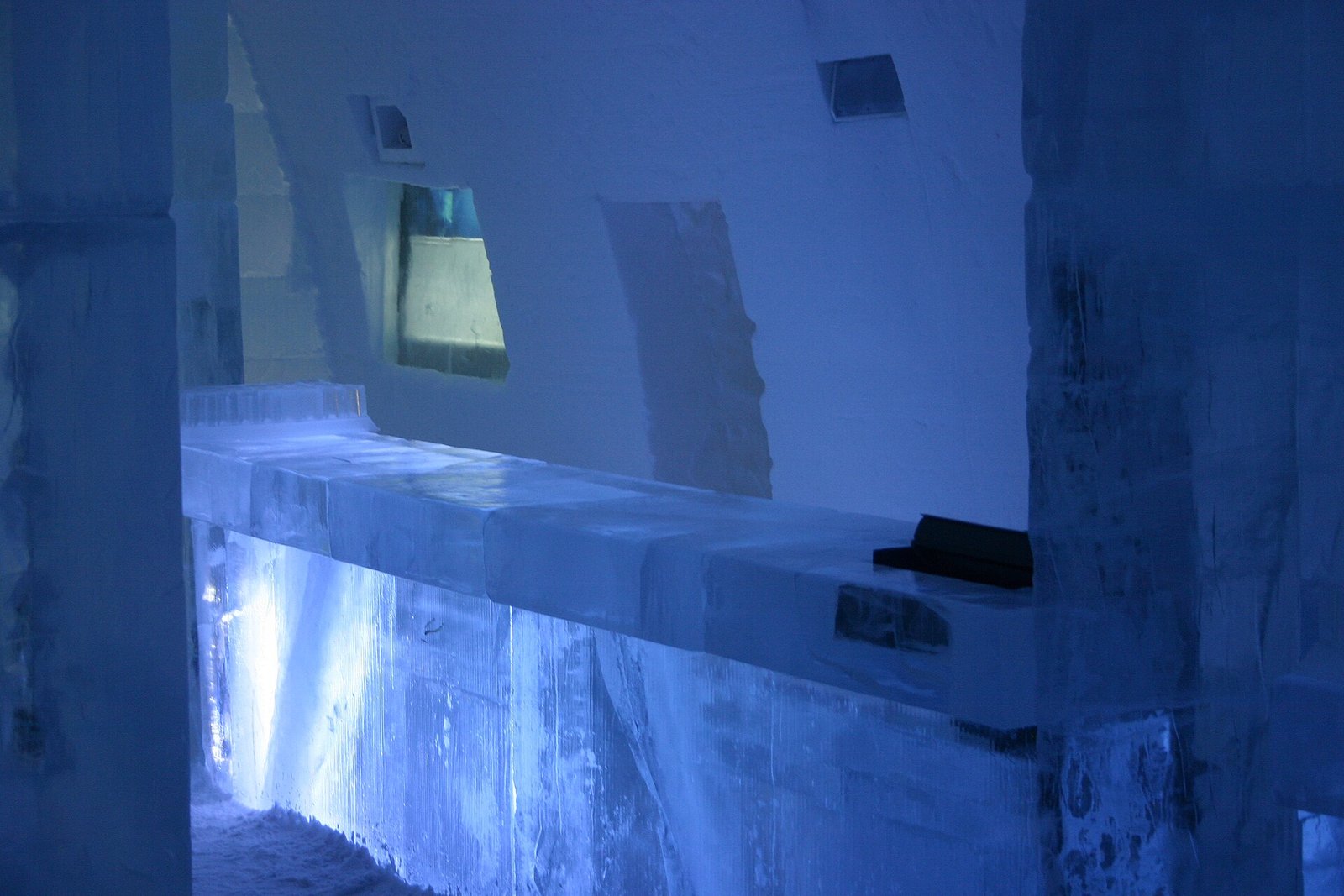
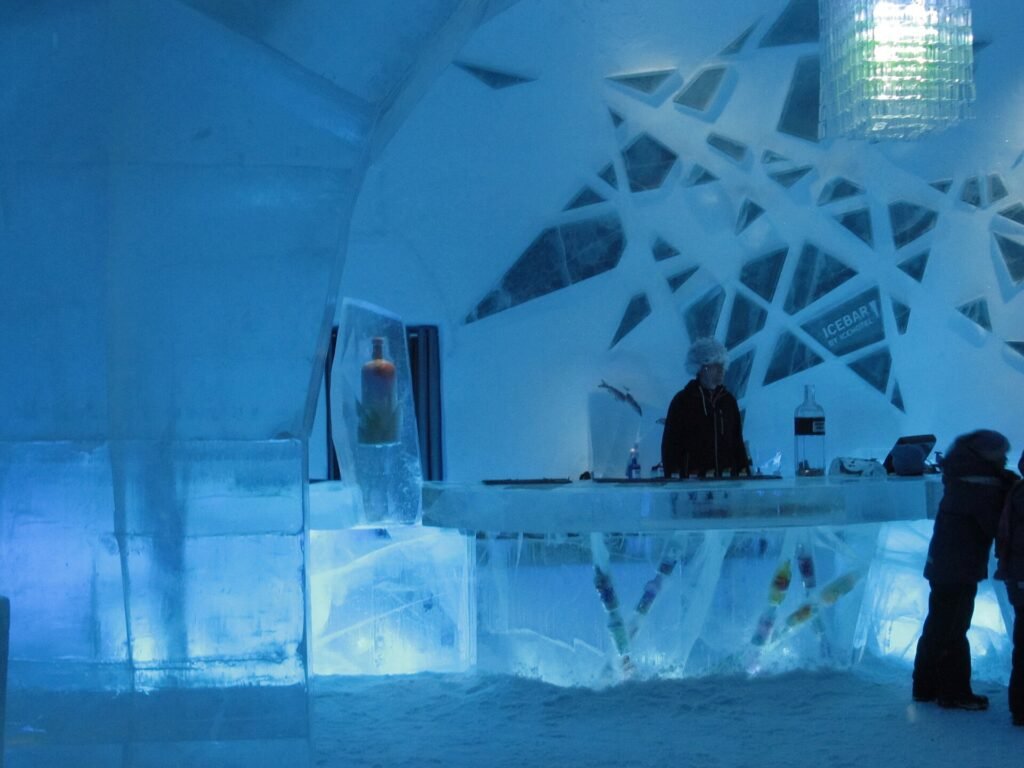
The ICEBAR is worth doing even if you’re not staying the night — a full bar carved from ice, drinks served in glasses that are also ice, which sounds like a gimmick until the glass starts sweating cold against your hand in a way an ordinary glass never does.
The part worth knowing before you book
This is not a wilderness experience dressed up as luxury — it’s closer to the reverse, an engineered, curated, thoroughly commercial operation that happens to be extraordinary. It can feel busy, particularly around midday when day-trip groups from Kiruna move through on guided tours. If you want the quieter version, stay the night; the building empties out considerably after the tour groups leave in the late afternoon, and a solo walk through the ice gallery after dark is a different experience entirely from the same walk at noon.
It’s also worth being honest that the winter structure and the 365 structure are genuinely different experiences. If what draws you is the full, sprawling seasonal ICEHOTEL rather than the permanent wing, you need to be there between December and April. Outside that window you get 365 only — real, and worth doing, but a smaller and more enclosed building than the one that gets photographed.
How it fits with the rest of the trip
Jukkasjärvi pairs naturally with Kiruna, seventeen kilometres away, and with Abisko further west — most Lapland itineraries treat this as one continuous arc rather than separate stops. If aurora is the primary reason you’re travelling this far north, book Jukkasjärvi as one night within a longer stay rather than the whole trip; the ice architecture is a few hours of genuine wonder, not a multi-day occupation, and the surrounding wilderness — dog-sledding, snowmobile routes, the Torne itself — is where the rest of a Lapland week is usually spent. Our piece on where to sleep for the northern lights makes the case for keeping the ice to an afternoon and the nights somewhere warm.
When to go
For the full seasonal building: December through April, with January–February giving the most complete version of the ice architecture, since the winter structure is still being finished into early winter. The 2026–27 season has a date on it — ICEHOTEL 37 opens on 11 December 2026.
For midnight-sun strangeness — a solar-cooled ice hotel under a sun that never sets — go in June or July instead. It’s a genuinely different trip: the surrounding country turns green, the river is fishable, and the contrast between the frozen interior and the endless daylight outside the door is, on its own, worth the visit.
Join