Destinations · Culture
The Tower That Closes When the City Fills
Most English-speaking visitors to Lille walk past the most important building in the city without registering it, and the reason is a translation problem rather than a failure of attention.
They see a tower. They file it under church. They move on.
It is not a church. It never was, and the fact that it isn’t is the whole point of it — a point this particular corner of Europe spent several centuries making, in brick, at considerable expense.
The third tower
Medieval Flanders built three kinds of tower, and they were arguments with one another.
The keep belonged to the lord. The bell tower belonged to the Church. The belfry belonged to the town — to its merchants, its weavers, its aldermen — and it went up tall specifically so that the other two would have to look at it. It housed the charter that guaranteed the town’s privileges, the bell that called its people, the archives, the treasury, and in some cases the prison. Civic power, made vertical, in a region where towns won their rights early and had every reason to advertise the fact.
Fifty-six of these towers are on the UNESCO World Heritage list, inscribed as a single property spread across two countries. Thirty-two Belgian belfries went on in 1999; twenty-three in northern France joined them in 2005, along with one more on the Belgian side. They range from the eleventh century to the seventeenth.
Once you know the shape, the whole region rearranges itself. Bergues has one. Douai, Arras, Béthune. And Lille has one — one, despite what the skyline suggests, because the other tall tower most visitors assume is a belfry is the Chamber of Commerce, and it is not on the list.
Except this one is from 1932
Here is where Lille declines to behave like a heritage postcard.
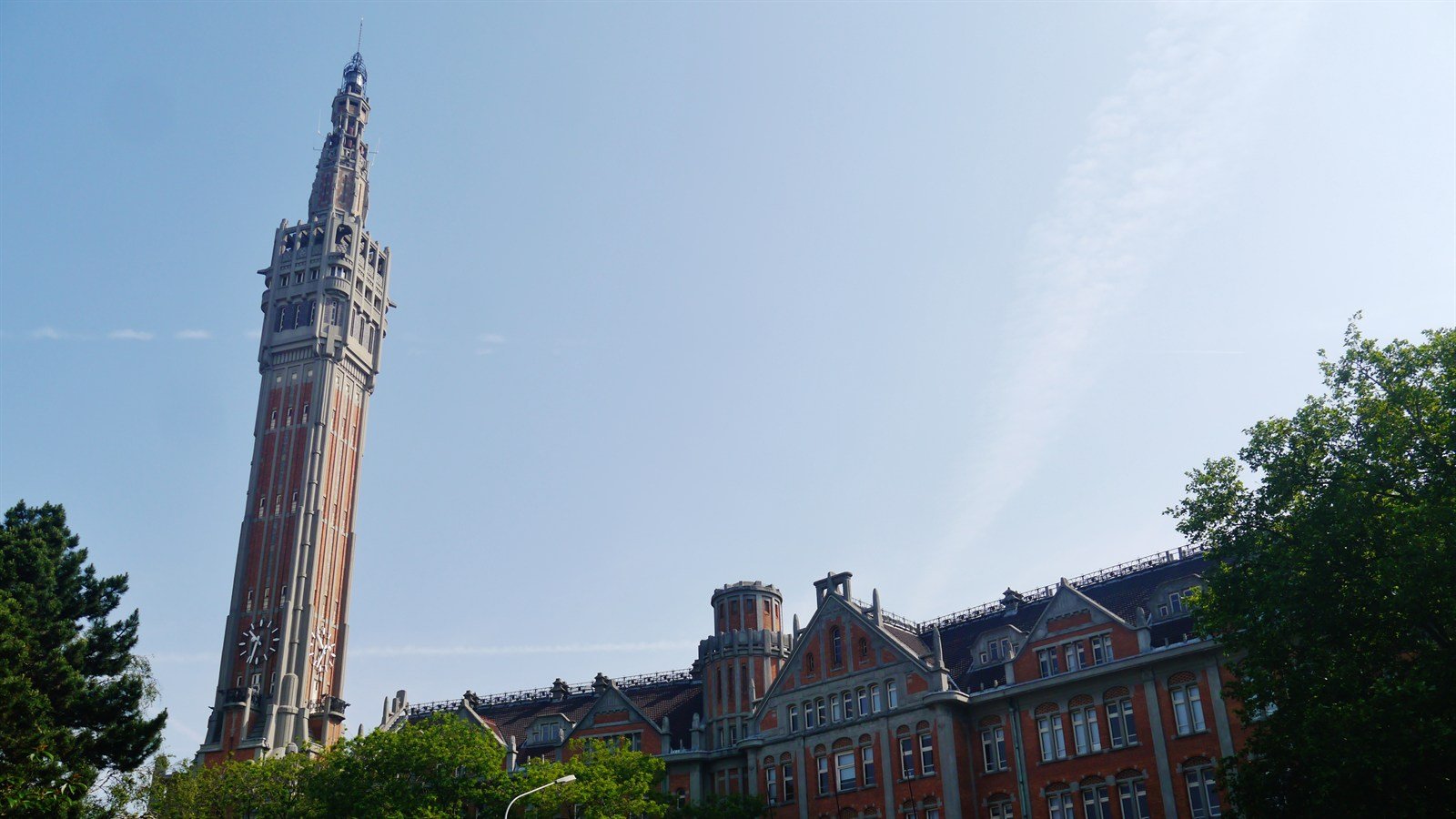
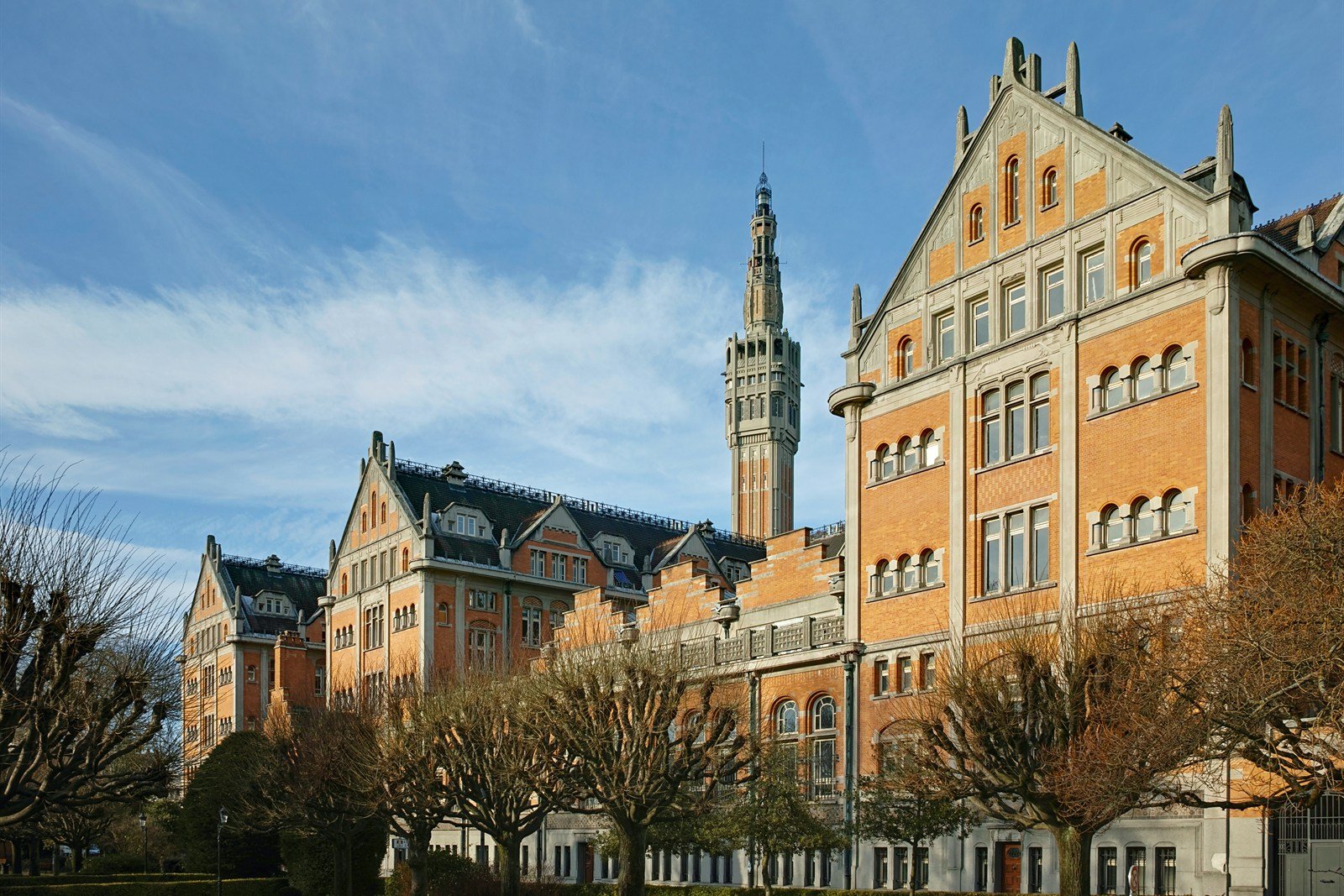
The tallest belfry in the region is not medieval. It is not even nineteenth century. Lille’s town hall was built between 1924 and 1932, to a design by Émile Dubuisson.
What stood before it burned. On 23 April 1916, with the city under German occupation, the old town hall on place Rihour caught fire and was destroyed. A thorough investigation by the occupying authority never established a cause. Along with the building went most of the city’s nineteenth-century archives and a large part of its library.
Hold that against what a belfry was for. The charter. The bell. The archives. The record of what the town was owed and had won. Lille lost the records, then spent eight post-war years building the tallest belfry in the region — in a different quarter, on a different square, larger than the thing that had burned.
Dubuisson took the form of the Flemish town house — the triangular stepped gable, the vertical rhythm, the whole vocabulary of civic Flanders — and built it in reinforced concrete. The most traditional shape available, in the most modern material available, at a moment when the city had every reason to want to look permanent.
The belfry reaches 104 metres, taller than any of the medieval towers it quotes.
That is not a preserved relic. That is a claim. A city that had just been occupied for four years rebuilt its symbol of self-government bigger than it had ever been, using a technology its ancestors would not have recognised, and then got it listed by UNESCO alongside towers six hundred years older.
Inside, the hall runs 107 metres between two rows of columns, and the staircases carry a fresco by the Icelandic painter Erró that tells the city’s history as a comic strip. This is not a building with a modest sense of itself.
The giants are on the plinth
At the base of the tower, carved into it, are two figures: Lydéric and Phinaert.
They are the founding giants of Lille — a legend involving a murdered prince, a forest, a duel, and the founding of a town, of the kind every Flemish city keeps somewhere. In much of French Flanders the giants are wicker-and-fabric effigies that come out for a carnival and spend the rest of the year in storage, out of sight.
Lille keeps its two outside, in stone, at the foot of the belfry. They are there on a wet Tuesday in February. Nobody stops for them.
And yet it closes
The belfry is open Tuesday to Sunday, ten to one and two to half past five. You get in by ringing at the large wooden door at its base, on place Simon Vollant, which feels wrong the first time and is correct. Only the ten o’clock slot needs booking; after eleven you simply turn up. It is free to everyone on the first Wednesday of the month, no reservation, first come.
It closes on the first of January, the first of May, Christmas Day —
— and for the Braderie de Lille.
The Braderie is the largest flea market in Europe, held on the first weekend of September, with a written record going back to 1127. For roughly thirty-four hours the entire city centre becomes a market. It is the one weekend of the year when Lille is unambiguously full.
It is also the one weekend you cannot go up the tower.
We have written elsewhere about why the Braderie is the wrong weekend to visit Lille if you have come for Lille rather than for the Braderie. This is the same argument made by an opening-hours notice. The UNESCO-listed monument that exists to symbolise the city’s independence is locked for the two days when the largest number of people are standing underneath it.
There is nothing sinister in it. A city centre at capacity and a 104-metre tower with a single staircase do not combine well. But it is a good illustration of a thing that is true of a lot of European cities and rarely said plainly: the moment a place is most itself in the tourist imagination is often the moment it is least available.
What you see from the top
A hundred steps, then a lift — or the rest on foot if you are feeling righteous about it. It is not accessible to wheelchair users, which is worth knowing before you plan around it. Forty minutes, give or take.
The view runs to somewhere between ten and fifty kilometres depending on the weather, which in this part of France is a meaningful range. On a grey day you get the city and its metropolis: the brick, the ring roads, Roubaix and Tourcoing sitting in the haze, the border with Belgium invisible and very close.
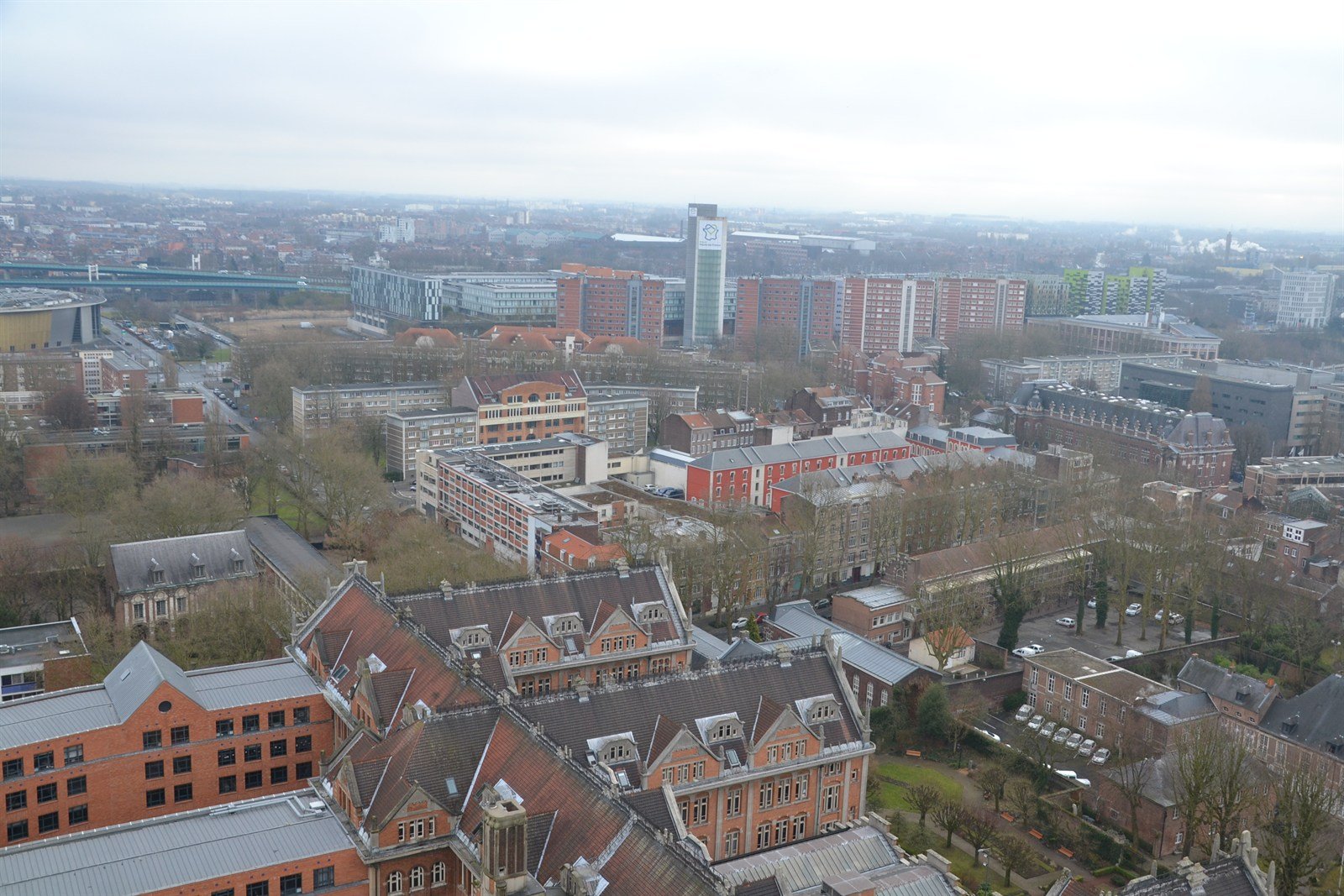
On a clear day you get the Lys valley, and beyond it, low on the horizon, the Monts de Flandre.
They are the only high ground for a long way in any direction, and they are where the other half of this culture lives — the towns where the giants are not carved in stone at the foot of a tower but built of wicker, six metres tall, kept behind an unmarked door and brought out twice a year.
You can see them from here. Getting there is a different article.
Belfry photograph by Zairon, CC BY-SA 4.0, cropped and resized; this modified version is released under the same licence.
Town hall photograph by Velvet, CC BY-SA 4.0, cropped and resized; this modified version is released under the same licence.
View from the belfry photograph by LucasD, CC BY-SA 4.0, resized; this modified version is released under the same licence.
Join