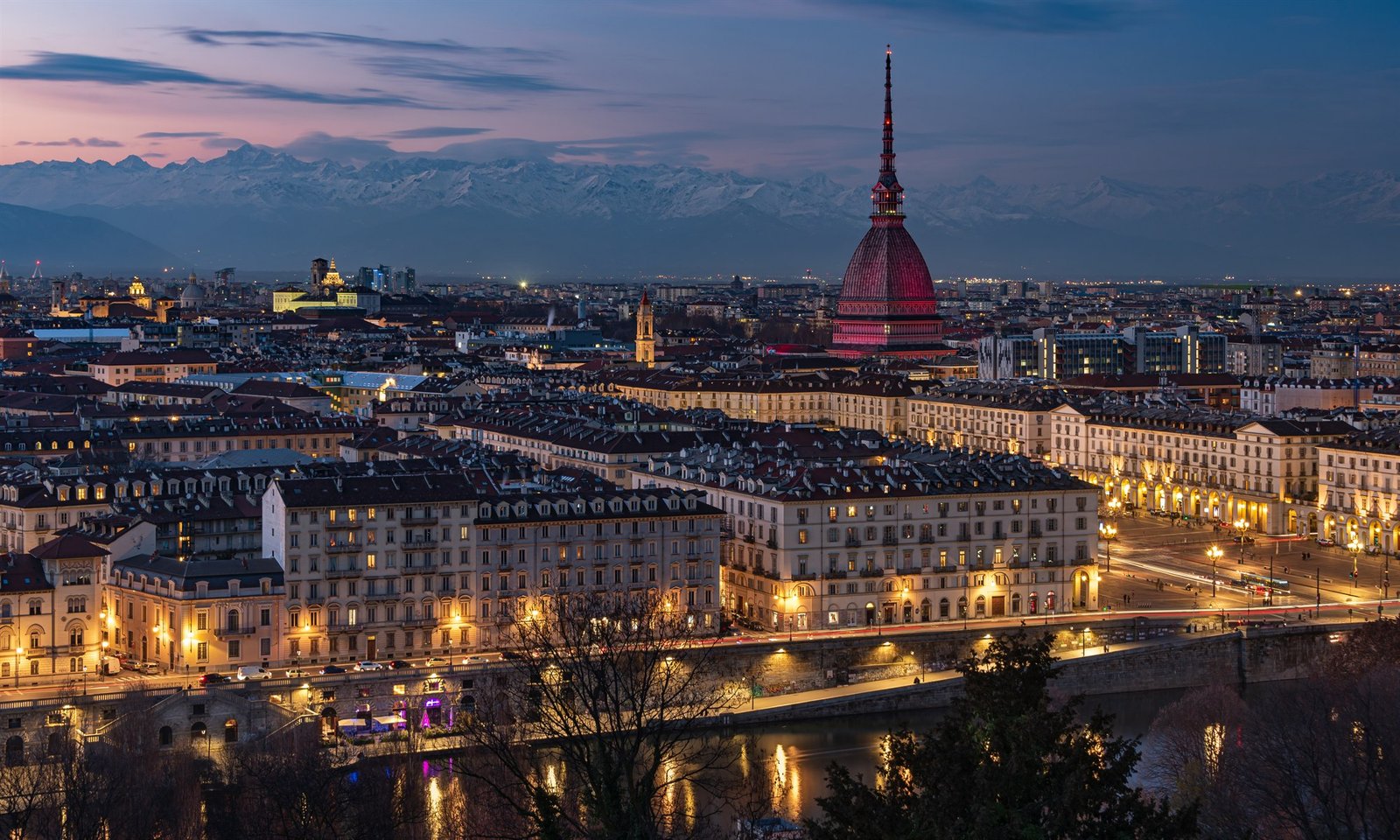
Turin: The Italian City Nobody Books
Smart Summary
Turin was the first capital of unified Italy, it has 18 kilometres of arcaded street, and outside Cairo it holds the most important collection of Egyptian antiquities in the world. It receives a fraction of the visitors of Florence, Venice or Milan.
- It is a Baroque city built to a plan — grid streets, arcades, café interiors that have not been touched in a century
- You will not queue, and that alone changes what a city break feels like in Italy
- Aperitivo was invented here, and the ritual is still the local one rather than the tourist one
- And it is the airport for the Langhe. If you are coming for truffle season, you are already flying here
The case against: it is not a postcard city and it does not try to be. If your Italy is Tuscan hill towns, this is a different country.
Why it is under-visited, and why that is your gain
Turin’s reputation was industrial for a century — Fiat, factories, work. That reputation outlived the reality by decades, and the international visitor map never quite updated.
What is actually there: a planned Baroque capital, arcades you can cross the centre under in the rain, the royal palaces of the House of Savoy, and a café culture with the interiors intact. The Egyptian Museum is the serious draw, and it is the kind of collection that in any other Italian city would come with a two-hour queue.
The practical consequence is that Turin is the one major Italian city where you can behave like a resident for three days without booking anything.
Turin before the Langhe
This is the argument that matters if you have read our Piedmont pages.
Turin is the natural airport for the truffle country, and most visitors treat it as a transfer. Two nights at the front of the trip changes the shape of the whole thing: you arrive, you decompress in a city with no queues, and you drive south rested rather than jet-lagged into a wine region.
It also works in reverse in December and January, when the legal white truffle season runs on well after the Alba market closes and the hills are quiet but cold. A city at either end gives you somewhere to be in the evening.
Where to stay — Hotel Victoria
Booking through these links may earn Sharp Voyage a commission, at no extra cost to you. It does not change what we recommend. How this works.
On Via Nino Costa, a quiet pedestrian street three blocks from Piazza San Carlo, behind a facade covered in ivy. You would walk past it.
It has been run by the same two families since it opened in 1961, now into the third generation — and that is the whole character of the place rather than a line of marketing. Inside, it does something unexpected: it feels English. Chintz, panelling, deep armchairs, a library atmosphere in the middle of an Italian Baroque city. Guests describe crossing the threshold and arriving somewhere else.
Rooms run across six classes, from Classic through to Suite, and no two are decorated alike.
The oddity worth knowing: the spa is called Iside and is themed on ancient Egypt — a nod to the Egyptian Museum, and to the owner’s own long-standing passion for it. It is open to non-residents as well as guests.
Book it if you want a house rather than a hotel, run by people who have been running it for sixty years, on a street with no traffic.
Skip it if you want contemporary Italian design. This is deliberately, eccentrically the opposite.
Verified: hotelvictoria-torino.com, August 2026
Or by the station — Hotel Roma e Rocca Cavour
A different proposition entirely, and the practical one if you are combining Turin with the wine country.
Directly opposite Porta Nuova, facing Piazza Carlo Felice and the Giardino Sambuy, in a mid-nineteenth-century building on one of the city’s most elegant squares. Rooms are each different, looking either onto the garden or onto the quiet inner courtyards. Breakfast is a buffet in a bright dining room or on the courtyard terrace.
It is family-run, and says so plainly — a balance between tradition and modernity, looked after by the people who own it.
Three practical advantages the other entry does not have. It has its own parking, with an underground garage a few metres from the door — genuinely rare in an Italian city centre and decisive if you are driving to or from the Langhe. Dogs are welcome, with notice. And you are across the road from the station, which matters if you are arriving late or leaving early for the hills.
Book it if you have a car, a dog, an early train, or all three.
Skip it if you want to be inside the old quarter. You are on the square in front of the station — central, but a different kind of central.
Verified: romarocca.it, August 2026
What is not worth it
- Treating Turin as a transfer. Two nights is the difference between an airport and a city.
- Comparing it to Florence. It is a planned Baroque capital, not a Renaissance hill town. Different century, different idea.
- Skipping the Egyptian Museum because you are not interested in Egypt. It is the reason people fly here.
- Eating late by Italian standards. Turin dines earlier than the south, and aperitivo at seven is a meal here, not a drink.
- Driving in the centre. Arcaded grid, restricted traffic zones, and everything within walking distance.
- August. The city empties and half of what is good about it closes.
Practical notes
Getting there. Turin has its own airport, and it is the one to use for the Langhe. Milan is an alternative with a longer drive.
Getting around. The centre is flat, gridded and arcaded — walkable in any weather, which is not true of most Italian cities.
When. Autumn is the best of it: truffle season south of the city, clear light, and the cafés at their most appealing. Spring is a close second. Avoid August.
Onward. The Langhe is roughly an hour and a half south. Our guide to where to stay there covers the villages.
FAQ
Is Turin worth visiting? Yes, particularly if you dislike queueing. It is a planned Baroque capital with major museums and a fraction of the visitors of comparable Italian cities.
Turin or Milan? Milan for shopping, design and connections. Turin for arcades, museums, cafés and calm. Turin is also far closer to the wine country.
How long do you need? Two nights is enough to see it properly, and it pairs naturally with a longer stay in the Langhe.
When is the best time? Autumn, which coincides with truffle season to the south. Avoid August.
City photograph: Torino (52728586867) by Jorge Franganillo, CC BY 2.0, cropped and resized.

Join